


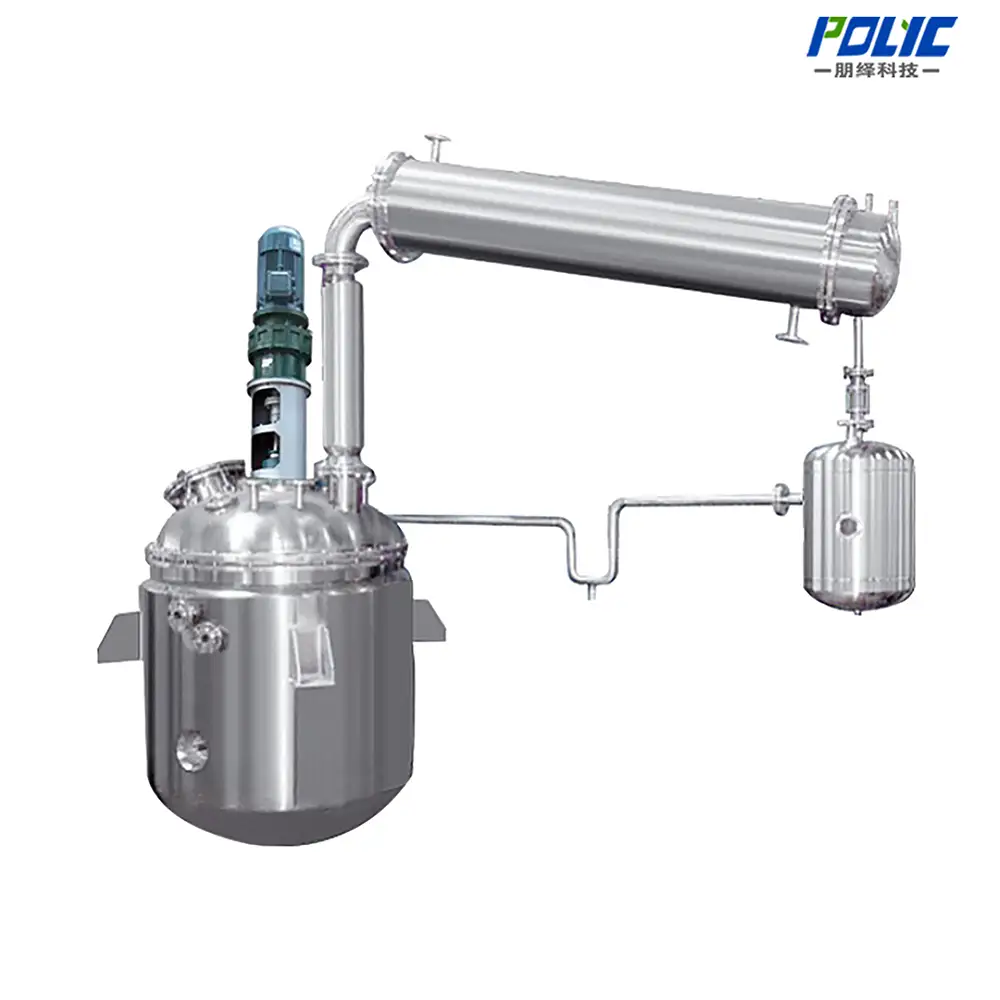


Core Technology & Working Principle
A resin cook changes character halfway through. The monomer charge is thin and easy to stir, then viscosity climbs through the condensation stage until the batch is a heavy syrup that the agitator has to physically fold rather than pump. That is why the drive is sized for the end of the reaction, not the start. Heat is the other half of the problem: most polymerization steps are exothermic once they kick off, so the jacket has to remove heat as readily as it supplies it, and the surface-to-volume ratio falls as vessels get larger — a 20,000 L vessel cannot shed heat the way a 500 L pilot can. That is the reason the thermal structure is a choice rather than a default. Finally the shaft seal has to hold while the vessel is pulled to vacuum to strip solvent and pull water off, because a seal that weeps air destroys both the vacuum and the resin color.
▲ Three Thermal Structures
A conventional jacket suits general heating and cooling. An external half-pipe limpet coil tolerates higher thermal fluid pressure and higher velocity with a thinner wall, which matters on large vessels. An internal coil puts the heat exchange surface directly into the product for the fastest ramp and the strongest exotherm control.
▲ High-Torque Agitator Drive
Anchor frames with PTFE wall scrapers, multi-stage Rushton turbines, pitched paddles and helical ribbons are matched to the viscosity curve of the batch. A heavy transmission reducer and IE3 motor carry that torque through the final, thickest stage of the cook.
▲ Pressure & Vacuum Sealing
Forged flanges carry a pressurized double-end cartridge seal with its own barrier fluid circuit, or a hermetic magnetic drive where the solvent is toxic or highly volatile. The seal holds from -0.098 MPa vacuum through 1.6 MPa positive pressure.
Precision Engineered Details
A resin reactor is never just one vessel. It is a vessel plus a condenser train, a receiver, and the steelwork that lifts the head to a workable height — and those four pieces are what decide whether the plant runs. The views below show how each one is detailed.
Resin Reactor Technical Parameters
This is a configured vessel rather than a fixed model line, so the table below lists what can be specified. Any combination is built against your process data sheet and P&ID.
| Parameter Category | Technical Specifications & Available Options |
|---|---|
| Available Capacity Range | 200 L, 500 L, 1,000 L, 3,000 L, 5,000 L, 8,000 L, 10,000 L, 20,000 L+ (customized) |
| Wetted Contact Metallurgy | Stainless steel SUS304, SUS316L (mirror polished, Ra < 0.4 µm) |
| Outer Jacket Metallurgy | Stainless steel SUS304 or high-strength carbon steel (Q235-B) |
| Thermal Structure Types | (a) Jacketed heating / cooling | (b) External limpet (half-pipe) coil | (c) Internal cooling coil |
| Heating Source Options | Thermal oil circulation, plant steam, electric heating elements, zero-distance induction |
| Agitator Impeller Types | Anchor with PTFE wall scrapers, multi-stage Rushton turbine, pitched paddle, helical ribbon |
| Shaft Seal Engineering | Liquid-cooled double mechanical seal, cartridge seal, packing gland seal, magnetic drive seal |
| Operating Pressure & Temperature | Full vacuum (-0.098 MPa) to 1.6 MPa positive pressure; process temperature up to 300 °C |
| Electrical & Explosion-Proof | 220V/380V/440V/480V (50Hz/60Hz); explosion-proof configurations are available upon request, confirmed against your hazardous-area classification |
*Complete resin synthesis systems — distillation columns, vertical tube condensers, water-oil decanters, buffer receiver tanks and PLC control consoles — are engineered to project P&ID specifications for turnkey chemical production lines. Reference projects in your industry are available on request.
Our Manufacturing Advantages
🏢 Direct Source Factory
Plate rolling, automatic submerged arc welding and mirror polishing are all done at our 9,000 m² Wuxi plant. Nothing is subcontracted to a broker, so the drawing you approve is the drawing that gets built.
✈️ 30–45 Days Fast Delivery
Standardized dished heads, stocked certified stainless plate and modular drive components let us ship standard resin reactor configurations within 30 to 45 days.
🛡️ Strict Quality Control
Every reactor goes through radiographic weld inspection (RT), jacket pressure testing and a mechanical seal run test before dispatch, under our ISO 9001 and CE certified manufacturing system.
🔧 3-Year Global Warranty
Every resin reactor is covered for three years on the main vessel body, the heating jacket, the transmission gearbox and the primary electric motor, with fast parts courier dispatch.
Target Application Spectrum
A resin reactor is specified where a liquid has to be turned into a polymer under a known thermal history — not simply blended:
Coatings & Paint Resins
Printing Ink Resins
Adhesives & Structural Glues
Sealants & Mastics
Ready to Discuss Your Resin Reactor Requirements?
Send us the resin type, batch size from 200 L to 20,000 L, heating medium and the pressure or vacuum envelope you need — our Wuxi process engineers will size the thermal structure, impeller and seal, then return a direct factory quote within 24 hours.
Technical FAQ
Short answers to the questions buyers ask before specifying a resin reactor or chemical synthesis kettle.