loading

Professional bead mill, mixers manufacturer and factory - Polyc

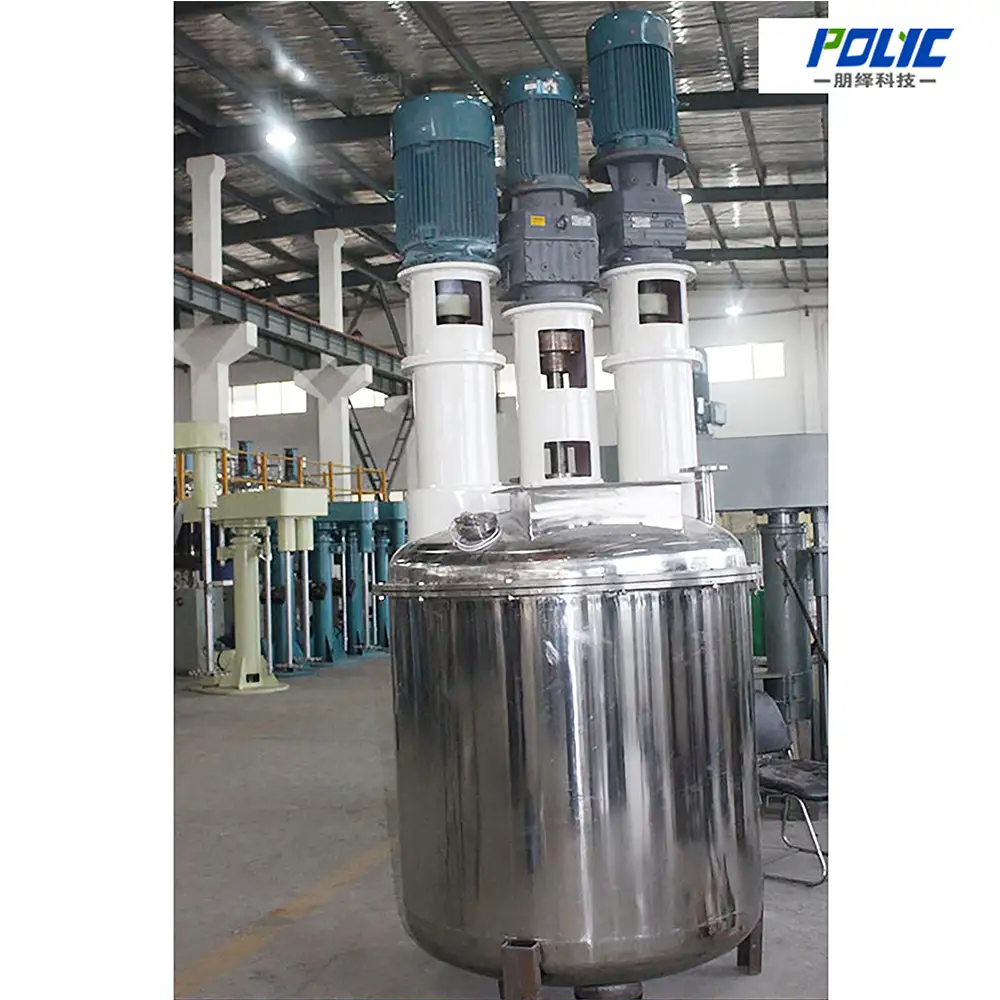
Multi Function Industrial Dispersing Mixing Kettle 1
Multi Function Industrial Dispersing Mixing Kettle 2
Multi Function Industrial Dispersing Mixing Kettle 3
Multi Function Industrial Dispersing Mixing Kettle 4
Multi Function Industrial Dispersing Mixing Kettle 1
Multi Function Industrial Dispersing Mixing Kettle 2
Multi Function Industrial Dispersing Mixing Kettle 3
Multi Function Industrial Dispersing Mixing Kettle 4

Multi Function Industrial Dispersing Mixing Kettle

Processing Capacity: Laboratory grade (5-50L) to industrial production grade (100L-5000L or larger).

Structure Type: Typically equipped with a high-speed dispersion disc and a low-speed scraper agitator (single-shaft, dual-shaft, or triple-shaft combination).

Frame Type: Lift-type (hydraulic/pneumatic) or fixed type.

Sealing Type: Optional mechanical seal, suitable for production under vacuum, pressurization, or inert gas protection.

Material: Material contact parts are typically made of stainless steel (SUS304, SUS316L, duplex stainless steel, etc.) for corrosion resistance and to prevent material contamination.

5.0
design customization

    oops...!

    no product data.

    Go to homepage
    ✔ 50 L to 20,000 L ✔ CE Certified & ISO 9001 ✔ 3-Year Global Warranty ✔ Direct Wuxi Factory Pricing

    PSK Multi-Function Dispersing Kettle with Three Working Shafts from 50 L to 20,000 L

    The PSK puts three different shafts into one vessel so a viscous formulation never has to be moved between kettles to be finished. A low-speed anchor with PTFE scrapers wipes the wall and folds the batch inward; a high-speed sawtooth disc breaks powder agglomerates; and an independent third shaft — a rotor-stator emulsifying head, a second disperser, a ribbon screw or a butterfly impeller, depending on the recipe — handles the fine stage. The reason this matters is that each of those jobs has a different optimum: scraping needs torque at 20 to 60 rpm, dispersion needs tip speed at 1,000 to 1,450 rpm, and emulsification needs a narrow rotor-stator gap. A single shaft cannot be optimal for all three, and three separate tanks means three transfers, three losses and three cleaning cycles per batch. The vessel seals to full vacuum at -0.098 MPa for air-free mixing, and handles formulations up to roughly 300,000 cps.

    Get a Configured Quote Chat on WhatsApp

    PSK multi-function dispersing kettle with three vertical drive motors on the vessel head in the Wuxi workshop

    50–20,000 L

    Capacity range

    0–1,450 rpm

    Agitator speed

    300,000 cps

    Maximum process viscosity

    -0.098 MPa

    Vacuum for degassing

    Core Technology & Working Principle

    Three jobs happen inside a dispersing kettle, and they do not share an optimum speed. Scraping the wall is a torque problem and runs slow — typically 20 to 60 rpm — because the anchor has to move a paste that behaves closer to a solid than a liquid. Breaking powder agglomerates is a tip-speed problem and runs fast, upward of 1,000 rpm at the disc rim. Reducing droplet or pigment size to the micron level needs a narrow rotor-stator gap with high relative velocity. Force all three onto one shaft and at least two of them run badly. Volumetric displacement decides the rest: on a 20,000 L batch, the material at the wall is metres away from the shaft, so an agitator that only stirs its own immediate neighbourhood leaves a stagnant thermal boundary layer that scorches while the middle of the batch is still cold. The PSK answers this by giving each duty its own driven shaft with independent VFD control, and by making the low-speed anchor the piece that keeps the whole batch circulating into the other two.

    ▲ Low-Speed Scraping Anchor

    A perimeter anchor fitted with flexible PTFE blades wipes the vessel wall and bottom on every revolution. It sets up the bulk 3D convective flow that carries material from the wall back into the center, and it keeps product moving across the heat-transfer surface so nothing sits long enough to burn on.

    ▲ High-Speed Dispersing Shaft

    The sawtooth disc runs at tip speeds that generate the hydraulic shear needed to wet out and de-agglomerate dry powders. This is the shaft that decides how much of the pigment or filler actually contributes to color strength and how much stays locked inside unwetted lumps.

    ▲ Independent Third Shaft

    The third axis is specified to the recipe: a rotor-stator emulsifying head for phase homogenization, a second disperser for high solids loading, a ribbon screw for paste turnover, or a butterfly impeller for very high viscosity. It is a driven shaft, not a fixed blade, so it can be run at a speed the other two cannot reach.

    Precision Engineered Details

    A three-shaft vessel is judged on how the shafts, the frame and the seal behave together, and on where the finished unit sits in the plant. The views below are from our own builds and installations.

    Sawtooth dispersing disc with milled teeth and the disc diameter marked on the face

    Sawtooth Dispersing Disc

    The disc carries milled teeth around its rim; the diameter is marked on the face because it is the number that sets tip speed. Teeth that have been worn round will still stir a batch but will stop de-agglomerating, which is why disc diameter and replacement interval are both specified per product.

    Row of multi-shaft dispersing kettles mounted through a steel mezzanine with overhead pipework

    Multi-Kettle Platform Layout

    On a production floor the vessels are set through a mezzanine so the drives sit at one level and discharge at another. Spacing, pipe routing between kettles and access for pulling a shaft are all decided at the layout stage, because a three-shaft head is not something you can lift out from below.

    Multi-shaft kettle drive assembly and local control panel mounted on a red structural mezzanine frame

    Three-Axis Drive on Mezzanine

    Independent motors for each shaft sit on a common head plate, with the local control panel mounted at the platform so an operator can set each axis while watching the batch. Hydraulic lift and discharge are also operated from this level rather than from underneath the vessel.

    Three-shaft kettle installed through a floor opening with drives above and discharge valve below

    Vessel Through-Floor Installation

    Setting the body through the floor rather than standing it on legs is what gives a large kettle a gravity discharge with a short, easily flushed outlet path. It also keeps the three drives at a workable height for maintenance instead of three metres in the air.

    PSK Series Technical Parameters

    Power figures are given as ranges because shaft sizing follows the viscosity curve of your product, not only the batch volume. A formulation that is thin at charge and thick at discharge needs more torque on the anchor than the nominal capacity alone would suggest.

    ModelCapacity (L)Main Motor Power (kW)Dispersing Power (kW)Emulsifying Power (kW)Agitator Speed (rpm)
    PSK-150 – 1002.2 – 45.5 – 7.54 – 5.50 – 1450
    PSK-2200 – 3004 – 5.511 – 157.5 – 110 – 1450
    PSK-3500 – 6007.5 – 1118.5 – 2211 – 150 – 1450
    PSK-51,000 – 1,20015 – 18.530 – 3718.5 – 220 – 1450
    PSK-82,000 – 3,00022 – 3045 – 5530 – 370 – 1450
    PSK-105,000 – 8,00037 – 4575 – 9045 – 550 – 1450
    PSK-1510,000 – 20,00055 – 75110 – 13275 – 900 – 1450

    *Parameters above are standard reference values. Working volume, motor ratings, blade combination and the specification of the third shaft are built against your process viscosity and production scale. Explosion-proof configurations are available upon request, confirmed against your hazardous-area classification. Reference projects in your industry are available on request.

    Our Manufacturing Advantages

    POLYC manufacturing plant in Wuxi, certified to CE and ISO 9001

    🏢 Direct Source Factory

    Steel fabrication, vessel welding and multi-shaft dynamic balancing are all done in our 9,000 m² Wuxi plant. Balancing three shafts on one head plate is the step most often subcontracted elsewhere, and it is the step that decides whether the machine runs quietly at 1,450 rpm.

    ✈️ 30–45 Days Fast Delivery

    Standardized vessel heads, stocked stainless plate and modular drive assemblies let us ship standard PSK configurations within 30 to 45 days from drawing approval.

    🛡️ Strict Quality Control

    Each unit goes through jacket pressure testing, run-in of all three shafts at operating speed, and a vacuum hold test on the sealed vessel before dispatch, under our ISO 9001 and CE certified manufacturing system.

    🔧 3-Year Global Warranty

    Every PSK kettle is covered for three years on the main structure and drive motors, with fast parts courier dispatch. Scraper blades, mechanical seals and drive belts are stocked as consumables.

    Target Application Spectrum

    A three-shaft dispersing kettle is specified where a single batch has to be dispersed, homogenized and degassed without a transfer:

    Structural adhesive flowing from a container as a clear viscous stream

    Structural & Assembly Adhesives

    Silicone sealant being applied from a cartridge into a prepared joint

    Silicone & PU Sealants

    Finished wall putty surface shown against a textured render finish

    Wall Putties & Plaster Pastes

    Stacked composite laminate panels with a woven surface pattern

    Composite & Laminate Pastes

    Ready to Consolidate Your Mixing Process?

    Send us the material type, the maximum viscosity in cps, the target batch size and whether the process needs vacuum — our Wuxi engineers will recommend the exact three-axis configuration and return a direct factory quote within 24 hours.

    Get a Configured Quote Chat on WhatsApp

    Technical FAQ

    Short answers to the questions buyers ask before specifying a multi-function dispersing kettle or triple shaft mixer.

    What is a multi-function dispersing mixing kettle used for?
    It is built for medium to ultra-high viscosity formulations, up to roughly 300,000 cps, that need macro stirring, fine solids dispersion and high-shear emulsification at the same time. Typical products are silicone sealants, structural adhesives, wall putties, glass glues and lithium battery pastes. The point of the third shaft is that all of those stages happen in one vessel, so the batch is never transferred between kettles mid-process.
    What is the difference between the PSK triple shaft mixer and a standard double shaft mixer?
    A standard double shaft mixer carries one low-speed anchor and one high-speed disperser. The PSK adds an independently driven third axis — a rotor-stator emulsifying head, a second disperser, a ribbon screw or a butterfly impeller — so high-shear emulsification and fine particle reduction can run in the same batch as dispersion rather than as a separate pass in another vessel.
    Can the PSK mixer operate under vacuum for air-free mixing?
    Yes. The PSK can be supplied with a vacuum system and heavy-duty mechanical seals rated to -0.098 MPa, which removes entrained air from viscous pastes while the shafts are running. A dimple jacket or external half-coil can be added on the same vessel for heating or cooling during the mixing cycle.
    Is an explosion-proof configuration available?
    Yes. For solvent-borne coatings and adhesives an explosion-proof configuration is available upon request, with sealed VFD electrical cabinets and static grounding. The exact motor and cabinet specification is confirmed against your hazardous-area classification before the order is released, since the required marking depends on the zone and the solvent involved.
    How is the third shaft specified for a particular product?
    It follows the viscosity range and the particle size target. A rotor-stator emulsifying head is used where two phases have to be bound or droplets reduced; a second disperser where solids loading is high and de-agglomeration dominates; a ribbon screw where the paste must be turned over rather than sheared; and a butterfly impeller at the top of the viscosity range where an anchor alone cannot move the batch.
    What warranty and after-sales support does POLYC provide?
    Every PSK kettle carries our standard 3-Year Global Warranty on the main structure and drive motors, with rapid spare parts dispatch. Scraper blades, mechanical seals and drive belts are treated as consumables and held in stock, since a three-shaft machine is only as good as the wear parts that keep its clearances correct.

    Related Resources

    PCM Concentric Double Shaft Mixer

    Two-shaft platform when a third axis is not needed.

    View product →

    PMX Vacuum Planetary Mixer

    Planetary platform for pastes above 100,000 cps.

    View product →

    PYR Emulsifying Kettle

    Dual-shaft rotor-stator kettle for stable emulsions.

    View product →

    Sealant Production Lines

    How sealant kettles are laid out into a line.

    Read guide →

    Get in touch with us
    Just leave your email or phone number in the contact form so we can send you a free quote for our wide range of designs!
    Related Products
    The company always adheres to the principle of quality first, adhering to the concept of value sharing and service winning, to provide you with more energy saving and more advanced chemical production equipment.
    Contact Us
    Contact person: Peter Yu
    Tel: +86 138 1677 4633
    WhatsApp: +86 138 1677 4633

    Add:
    Shanghai office address: No.712, Block A, Greenland Supreme, 6167-6169, Oriental Meigu Avenue, Fengxian District, Shanghai


    Copyright © 2026 Polyc Machine | Sitemap
    Product Lives
    Contact us
    email
    whatsapp
    Contact customer service
    Contact us
    email
    whatsapp
    cancel
    Customer service