




Core Technology & Working Principle
An emulsion is decided by droplet size, and droplet size is decided by where shear happens. In a closed kettle the shear zone is small — a rotor a few hundred millimeters across inside a stator cage. Everything outside that cage is, from the emulsion's point of view, stagnant. Creams, ointments, mayonnaise and resin pastes are non-Newtonian and thick enough that they will not drain into the head by gravity, so a single-shaft high-shear unit stalls: the material around the head emulsifies perfectly while the bulk of the batch stays coarse, and the result is a batch that separates in the jar three weeks later. The dual-shaft layout solves that geometrically. The low-speed anchor sweeps the full vessel wall and the full batch volume, folding material inward and downward into the head, while the head re-cuts it. Control of droplet size becomes control of circulation, and circulation is a mechanical question — scraper clearance, anchor speed, and whether the anchor actually touches the wall rather than leaving a 5 mm film to bake on the heated surface.
▲ Rotor-Stator Shear
A toothed rotor turns inside a slotted stator. Its rotation creates suction at the center that pulls product in, then centrifugal force drives it out through the stator slots. The droplet is broken by the combination of hydraulic shear in the gap and mechanical tearing at the slot edges, which is what takes a two-phase mix down toward sub-micron size rather than merely stirring it.
▲ PTFE Wall-Scraping Anchor
The anchor runs at 35 to 55 rpm with PTFE scraper blades set against the vessel wall. It does two jobs at once: it pushes the batch back into the shear head, and it keeps product moving across the heat transfer surface so nothing sits still long enough to scorch. On a jacketed vessel, a stagnant film at the wall is a burned batch waiting to happen.
▲ Vacuum Degassing
The vessel seals to -0.098 MPa, so air entrained during powder charging and vortexing is pulled out while the emulsion is being built rather than after. Removing air during emulsification stops the oxidative color drift that shows up in creams and sealants, and it stops the density variation that makes a filled tube weigh differently from batch to batch.
Precision Engineered Details
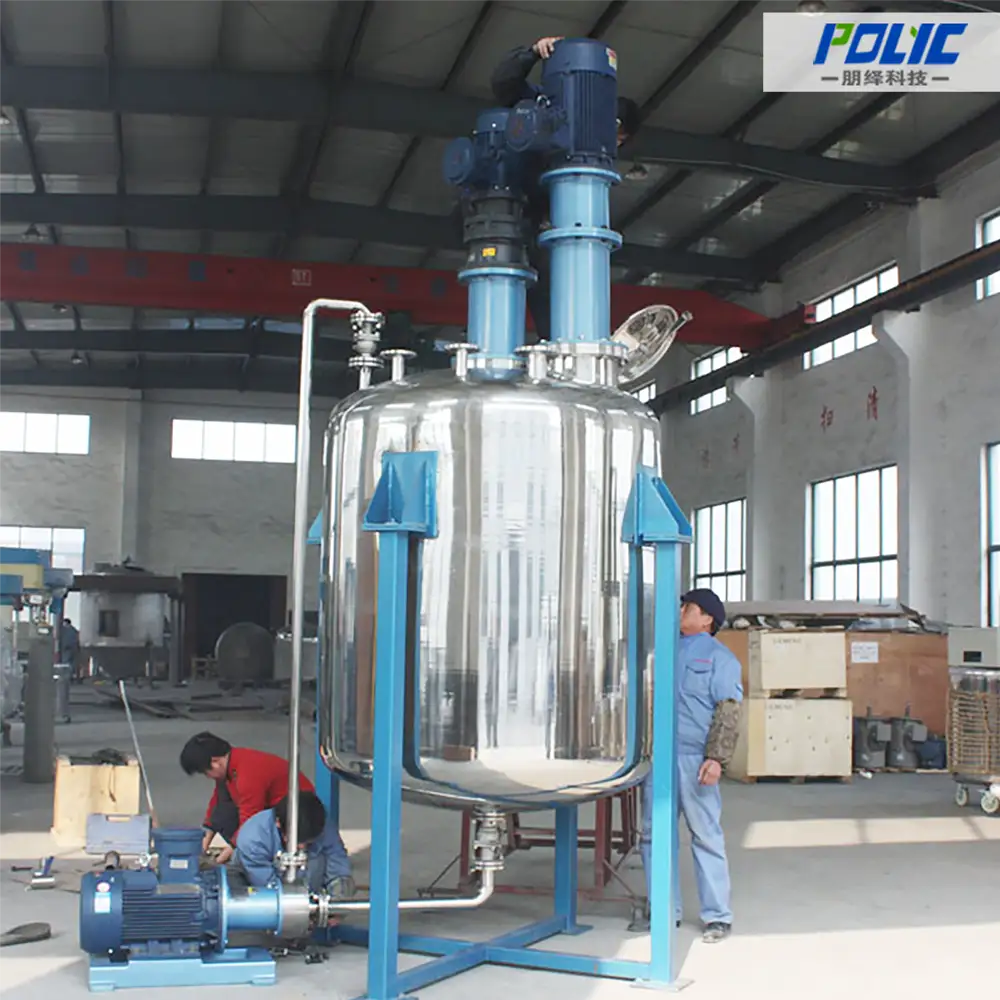
What decides whether an emulsifying kettle performs is not the vessel shell but the head geometry, the scraper fit, the drive and the way the unit sits in a line. The views below are from our own builds and installations.
PYR Emulsifying Kettle Technical Parameters
Standard models are listed below. Volume, diameter and motor sizing move together — a larger vessel needs a wider anchor sweep and more emulsifier power to hold the same circulation per unit volume.
| Model | Volume (L) | Vessel Diameter (mm) | Vessel Height (mm) | Emulsifier Motor (kW) | Emulsifier Speed (rpm) | Anchor Motor (kW) | Anchor Speed (rpm) |
|---|---|---|---|---|---|---|---|
| PYR-1000 | 1,000 | 1,100 | 1,550 | 11 | 3,000 | 4.0 | 55 |
| PYR-2000 | 2,000 | 1,300 | 1,900 | 18.5 | 1,500 | 4.0 | 35 |
| PYR-3000 | 3,000 | 1,500 | 2,300 | 30 | 1,500 | 7.5 | 35 |
| PYR-5000 | 5,000 | 1,900 | 2,300 | 22 × 2 pcs | 1,500 | 15 | 35 |
*The 5,000 L model runs two emulsifying heads on the same vessel rather than one larger head, because shear scales with tip speed at the gap and a single oversized rotor cannot hold that gap across the full batch height. Custom volumes, dual-voltage motors (220V/380V/440V, 50Hz/60Hz) and explosion-proof configurations are available upon request, confirmed against your hazardous-area classification. Complete emulsifying lines — water and oil phase tanks, transfer pumps, vacuum systems and control cabinets — are engineered to project specifications. Reference projects in your industry are available on request.
Our Manufacturing Advantages
🏢 Direct Source Factory
Vessel rolling, TIG welding, mirror polishing and the CNC machining of the rotor-stator head are all done in our 9,000 m² Wuxi plant. The head is the part that decides droplet size, so it is machined in-house rather than bought in and adapted.
✈️ 30–45 Days Fast Delivery
Standard dished heads, stocked stainless plate and modular dual-drive assemblies let us ship standard PYR configurations within 30 to 45 days from drawing approval.
🛡️ Strict Quality Control
Every kettle is pressure tested on the jacket circuit, the head and anchor shafts are dynamically balanced, and each unit runs a no-load and water test on both drives before dispatch, under our ISO 9001 and CE certified manufacturing system.
🔧 3-Year Global Warranty
Every PYR kettle is covered for three years, with fast parts courier dispatch. Scraper blades, seals and drive belts are stocked as consumables so a worn part does not take the line down for a month.
Target Application Spectrum
A dual-shaft emulsifying kettle is specified where two immiscible phases have to be locked together and stay locked:
Cosmetics & Personal Care
Topical & Cream Bases
Sealants & Adhesive Bases
Paints & Coating Pastes
Ready to Discuss Your Emulsifying Kettle Requirements?
Send us the two phases, the target viscosity at filling, the working volume and whether the process runs under vacuum — our Wuxi engineers will size the head geometry, anchor clearance and drive power, then return a direct factory quote within 24 hours.
Technical FAQ
Short answers to the questions buyers ask before specifying an emulsifying kettle or high-shear homogenizing vessel.