


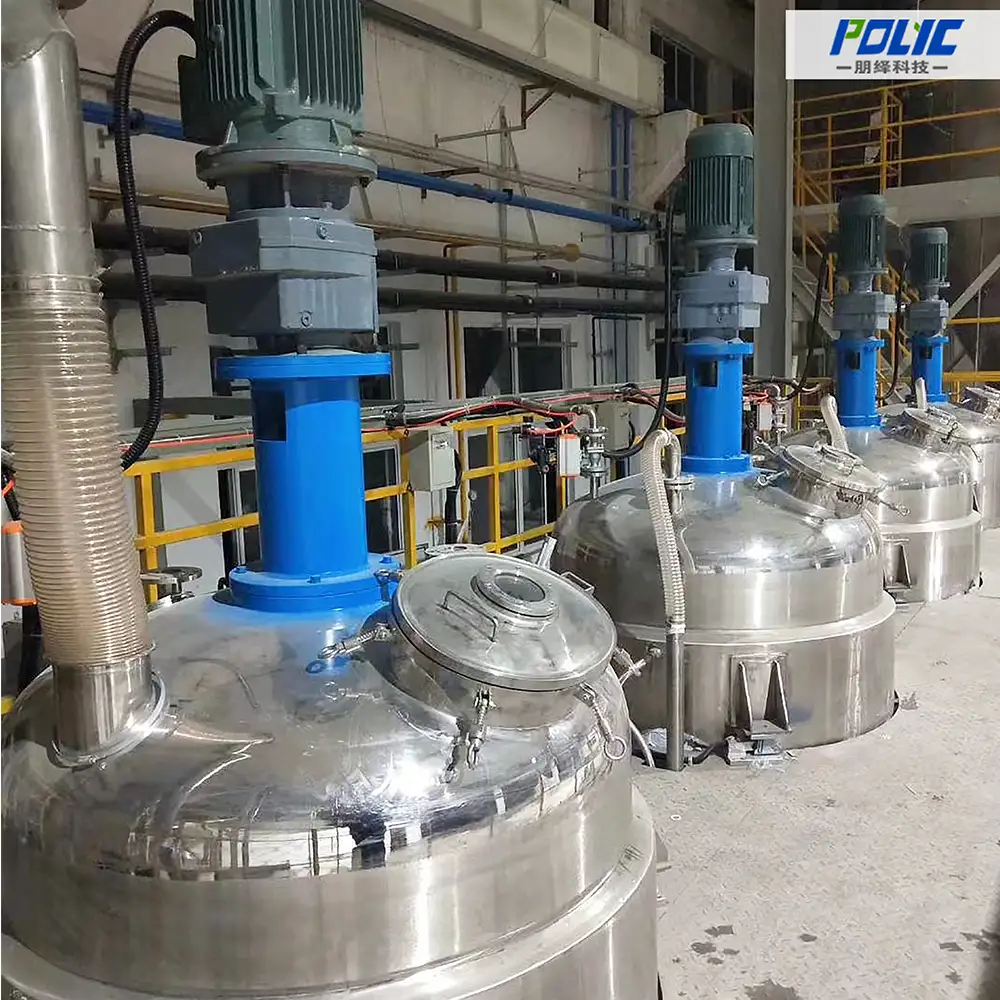


Core Technology & Working Principle
A tinting kettle is asked to do two contradictory things. During let-down it holds a low-viscosity resin solution that flows easily and only needs gentle axial turnover to stay uniform. During the tinting pass it takes in colorant paste — often far heavier than the base — and that paste will sink and stratify unless the agitator reaches the wall and the bottom rather than just stirring the middle. Get the impeller wrong in one direction and you either fail to dissolve the pigment or you fail to keep a large dilute batch moving. Heat is the second constraint: color development and viscosity both depend on temperature, and a jacket that only heats the center leaves the wall cold, so the batch reads differently at the top and bottom of the tank. That is why the wall-scraping anchor matters even on a "simple" blending kettle — it is the part that keeps the heat-transfer surface in contact with moving product instead of a stagnant film.
▲ Jacket & Thermal Control
Single-wall, dimple jacket or external half-pipe limpet coil, fed with steam, hot water or thermal oil at up to 250 °C. A dimple jacket gives uniform coverage over a dished surface; a half-pipe coil tolerates higher fluid pressure and velocity with a thinner wall. The jacket pressure rating on the standard range is up to 0.3 MPa.
▲ Agitator Matched to the Batch
Anchor with PTFE wall scrapers for heavy pastes, multi-tier pitched blades for axial circulation, a marine propeller for low-viscosity let-down, a helical ribbon for very high viscosity, or a sawtooth Cowles disc where dry powder has to be pulled into the liquid quickly. Standard shaft speed on the PEK range runs 10 to 80 rpm at the low-speed end.
▲ Vacuum, Pressure or Open
The same vessel pattern is built three ways: an open atmospheric blending tank, a vacuum-tight kettle down to -0.095 MPa for bubble-free de-aeration before filling, or a pressure-rated reactor. Which one you need is decided by the process, not by the tank — and it is settled before fabrication because the shell thickness and the flange standard differ.
Precision Engineered Details
Inside a mixing kettle the parts that decide whether a batch comes out uniform are the scraper fit, the impeller set and what happens at the discharge. The views below are from our own builds and from customer lines.
PEK Technical Parameters
Working capacity is the usable batch volume; total vessel volume is the full shell including the freeboard above the liquid line. Motor power and shaft speed are given as ranges because both follow the viscosity of your product.
| Model | Working Capacity (L) | Total Vessel Volume (L) | Motor Power (kW) | Agitator Speed (rpm) | Jacket Pressure (MPa) | Approx. Weight (kg) |
|---|---|---|---|---|---|---|
| PEK-500 | 500 | 650 | 4.0 – 7.5 | 10 – 80 | ≤ 0.3 | 950 |
| PEK-1000 | 1,000 | 1,300 | 7.5 – 11.0 | 10 – 80 | ≤ 0.3 | 1,600 |
| PEK-2000 | 2,000 | 2,600 | 11.0 – 18.5 | 10 – 60 | ≤ 0.3 | 2,800 |
| PEK-3000 | 3,000 | 3,900 | 15.0 – 22.0 | 10 – 60 | ≤ 0.3 | 3,800 |
| PEK-5000 | 5,000 | 6,500 | 22.0 – 37.0 | 10 – 50 | ≤ 0.3 | 5,200 |
| PEK-10000 | 10,000 | 12,500 | 37.0 – 55.0 | 10 – 40 | ≤ 0.3 | 8,900 |
*Parameters above represent standard configurations. Custom capacities, coaxial dual-shaft agitation, higher jacket pressure ratings, mechanical seals and explosion-proof configurations are built on request, with the specification confirmed against your process data sheet. Reference projects in your industry are available on request.
Our Manufacturing Advantages
🏢 Direct Source Factory
Vessel rolling, automated welding and mirror polishing are done in our 9,000 m² Wuxi plant. Dimple and limpet jackets are formed and welded in-house, which is why the jacket pressure rating is a fabrication fact rather than an assumption.
✈️ 30–45 Days Fast Delivery
Standardized vessel heads and stocked stainless sheet let us ship standard PEK configurations within 30 to 45 days from drawing approval.
🛡️ Strict Quality Control
Every kettle goes through non-destructive weld inspection, a jacket pressure test and a run-in of the agitator and seal before dispatch, under our ISO 9001 and CE certified manufacturing system.
🔧 3-Year Global Warranty
Every PEK kettle carries our standard 3-Year Global Warranty covering the main vessel body, the agitator shaft and the primary electric drive motor, with rapid spare parts dispatch.
Target Application Spectrum
A mixing and tinting kettle is specified wherever a liquid batch has to be blended, let down and brought to a color in the same vessel:
Printing & Packaging Inks
Pigment & Colorant Pastes
Architectural & OEM Paints
Cosmetic Emulsions
Ready to Discuss Your Mixing and Tinting Kettle Requirements?
Tell us the batch volume, the working viscosity, the heating or cooling duty and whether the process needs vacuum — our Wuxi engineers will match the jacket type, impeller and motor, then return a direct factory quote within 24 hours.
Technical FAQ
Short answers to the questions buyers ask before specifying a jacketed mixing kettle or tinting vessel.