



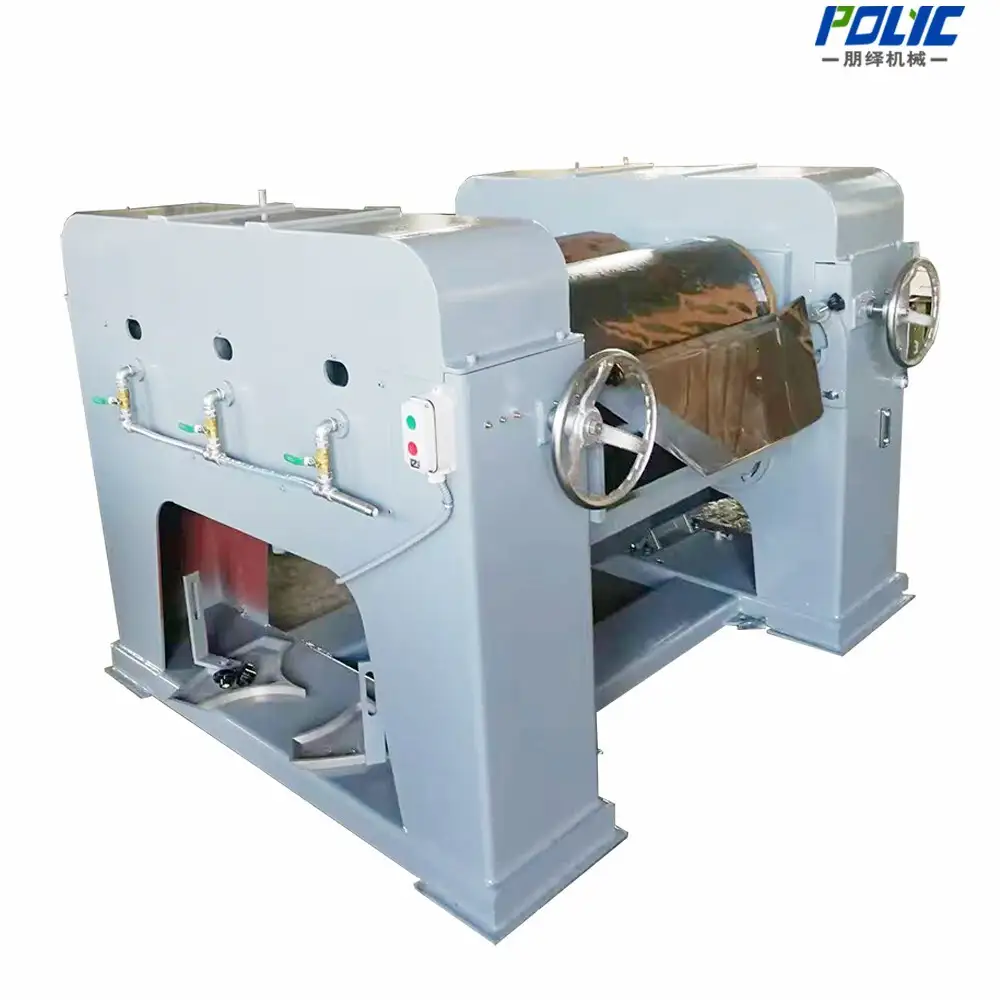
Core Technology & Working Principle
Working principle: Paste is fed between the slow and middle rollers. It transfers from the slow roller to the middle roller, experiencing its first intense shear. It then transfers to the fast roller for a second shear stage before a tight discharge apron scraper blade peels the perfectly refined ink into the collection apron.
Precision Engineered Details
PTM Technical Parameters
| Model | Roller Dia. (mm) | Roller Length (mm) | Motor Power (kW) | Output Range (kg/h) |
|---|---|---|---|---|
| PTM-150 | 150 | 300 | 2.2 kW | 10 - 20 |
| PTM-260 | 260 | 650 | 7.5 kW | 20 - 50 |
| PTM-406 | 406 | 1000 | 22.0 kW | 50 - 150 |
*Note: Maximum processing capacity depends heavily on initial paste viscosity and required fineness. Customizations including hydraulic roller tensioning systems and Ceramic (Alumina/Zirconia) rollers are available upon request.
Our Manufacturing Advantages
POLYC's 9,000 m² manufacturing facility in Wuxi. We handle 100% of precision roller machining, gear transmission assembly, and dynamic balancing in-house.
Target Application Spectrum
Technical FAQ
Why use a triple roller mill instead of a bead mill for offset ink?
Offset inks possess extreme viscosities (up to 3,000,000 cps) which would instantly clog a standard bead mill. A triple roller mill utilizes high-pressure nip gaps between three counter-rotating rollers to physically crush agglomerates in stiff, non-flowing pastes.
How does the PTM series prevent the ink from overheating?
Extreme shear generates significant frictional heat. Our PTM series features internal water cooling manifolds within the chilled alloy rollers. This precision thermal control maintains the temperature rise (ΔT) to strictly below 10°C, preventing thermal degradation of sensitive ink pigments.
How is the roller gap adjusted?
Standard PTM models feature precision manual handwheel adjustment for the roller nip gap. Fully automated hydraulic gap tensioning systems with digital PLC readouts are available for high-end industrial models.
What materials are the rollers made from?
The rollers are cast from high-hardness chilled alloy steel, precision-ground and mirror-polished to ensure perfect parallelism. Aluminum oxide or Zirconia ceramic rollers are available upon request for metal-free electronic pastes.
What is the lead time and warranty for POLYC triple roller mills?
Standard PTM models are delivered in 30-45 days from drawing confirmation. Every unit is backed by a 3-Year Global Warranty covering the main structural frame, drive gearboxes, and electric motors.