


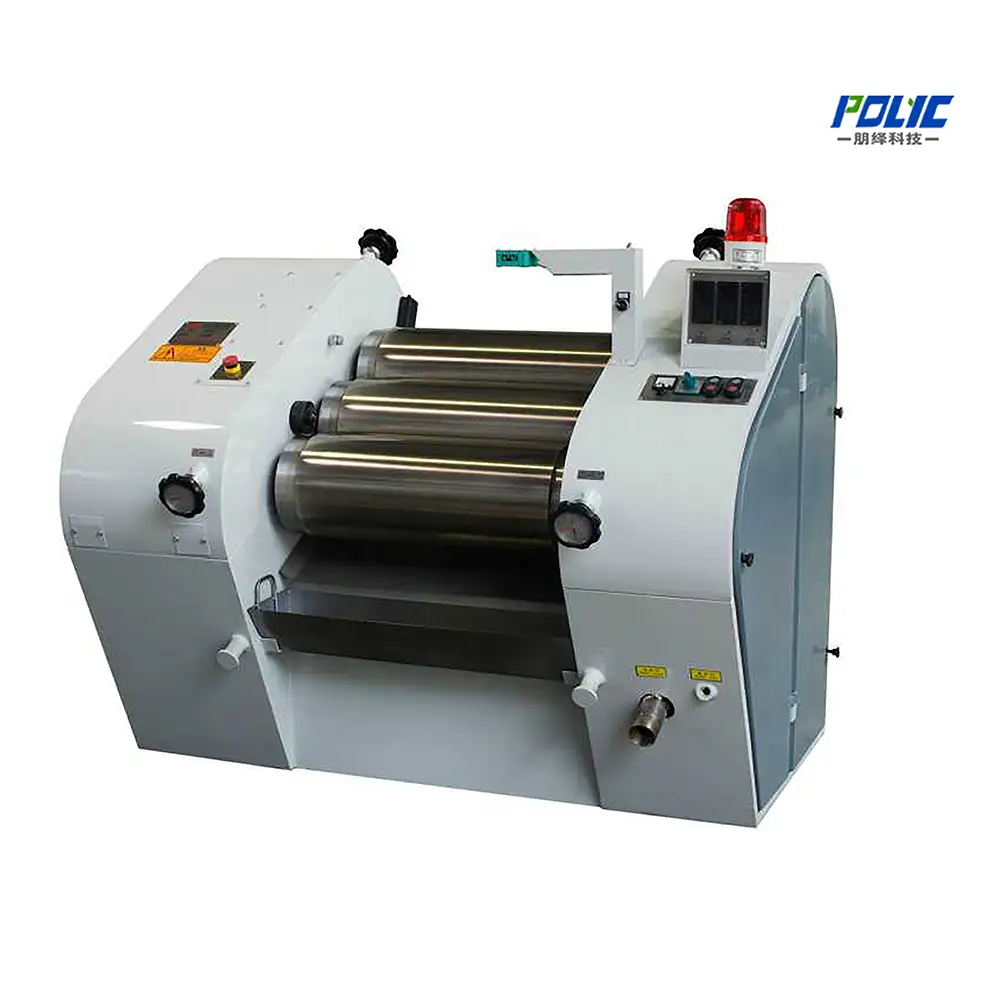


Core Technology & Working Principle
Three-roll milling works by shear inside a gap, and the gap is the whole machine. Paste enters the first nip from the rear; the surface speed difference between the two rolls that form that nip drags the material through, and the agglomerates caught in it are torn apart by the velocity gradient rather than smashed by impact. Film thickness at the nip is measured in microns, so a change of a few microns in gap position changes the finished fineness more than any change of speed or pressure. That is the engineering problem the hydraulic system exists to solve. On a heavy paste the separating force pushes the rolls apart continuously, heat grows the roll body, and a hand-set screw that was correct at 08:00 is no longer correct at 14:00 unless someone keeps re-checking it. The PHM closes that loop hydraulically and adds three mechanical decisions that matter just as much: chilled cores, hardened roll surfaces, and a scraper knife that takes the film off instead of letting it ride back into the nip.
▲ Hydraulic Nip Loading at 6.3 MPa
A double-impeller pump station pressurises the rams that position the front and rear rolls against the fixed middle roll. Because pressure — not thread position — defines the clamp, the same setting reproduces the same fineness on the next batch and on the next machine. One-touch pressure release opens the nips for cleaning and for clearing a blockage without backing off a screw by hand.
▲ Chilled Cores Against Thermal Bowing
Friction in the nip heats the roll body, and it heats it unevenly — the working length runs hotter than the journals. The roll then bows, the gap goes barrel-shaped, and fineness drifts from the center of the roll to its ends. All three rolls are bored for continuous chilled-water circulation, which holds thermal rise to a low level and keeps the gap parallel across the full working length. This is the single largest difference between a mill that holds tolerance all shift and one that does not.
▲ Scraper Knife Take-Off
The milled film leaves on the fast front roll and is lifted off by a hardened knife held against the roll face. Knife angle and contact pressure decide whether the film releases cleanly into the collection trough or is dragged back through the nip a second time, which double-shears the product and drives temperature up. The knife is adjustable and treated as a wear part, because a dull edge is the usual reason a mill stops delivering its rated fineness.
Precision Engineered Details
Three-roll performance is decided at the roll face, at the knife, and at the point where the operator stands. The views below are from our own builds and from machines running in production.
PHM Series Technical Parameters
The series spans three roll diameters. Motor power, hydraulic motor power and overall dimensions are listed per model because the hydraulic loading gear differs between the single-circuit and the hopper-equipped machines, not only the frame size.
| Model | Roller Diameter (mm) | Working Length (mm) | Motor Power (kW) | L × W × H (mm) | Hydraulic Motor Power (kW) | Hydraulic System (MPa) | Weight (kg) |
|---|---|---|---|---|---|---|---|
| PHM150 | 150 | 300 | 3 | 950 × 950 × 1,080 | 0.375 | 6.3 | 520 |
| PHM260 | 260 | 650 | 22 | 1,600 × 1,280 × 1,260 | 1.5 | 6.3 | 2,000 |
| PHM400 (without hopper) | 400 | 1,300 | 55 | 2,634 × 1,750 × 1,600 | 1.5 | 6.3 | 4,800 |
| PHM400 (with hopper) | 400 | 1,300 | 55 | 2,634 × 1,750 × 2,295 | 1.5 × 2 | 6.3 × 2 | 5,200 |
*Achievable fineness depends on the material and the gap setting; the practical working range is typically 3 to 15 μm. Roll materials are available in chilled cast iron, hardened alloy steel, zirconia or alumina ceramic. The hopper-equipped PHM400 is listed with a second 1.5 kW hydraulic motor and a second 6.3 MPa circuit — the hopper feed arrangement is confirmed against your process at quotation stage. Explosion-proof configurations are available upon request, confirmed against your hazardous-area classification. Reference projects in your industry are available on request.
Our Manufacturing Advantages
🏢 Direct Source Factory
Roll casting, rough and finish grinding, dynamic balancing and frame machining all happen inside our 9,000 m² Wuxi plant. A three-roll mill is only as good as the concentricity and balance of its rolls, and both of those are lost the moment that work is subcontracted out.
✈️ 30–45 Days Fast Delivery
Cast roll blanks and standardized hydraulic power units are held in stock, so a standard PHM configuration ships within 30 to 45 days of drawing approval. Ceramic rolls and special voltages are quoted with their own lead time.
🛡️ Strict Quality Control
Every roll is hardness checked and measured for concentricity; every hydraulic circuit holds pressure under test before the machine is assembled; and each unit runs under load with paste before dispatch, under our ISO 9001 and CE certified manufacturing system.
🔧 3-Year Global Warranty
Every PHM mill carries our standard 3-Year Global Warranty on the main structure, the roll drive gearbox and the hydraulic pump motor, with fast air dispatch of spares. Scraper knives, seals and hydraulic filters are stocked as consumables.
Target Application Spectrum
A hydraulic three-roll mill is specified where the product is a paste rather than a liquid, and where fineness has to be reached without thinning the batch. Alongside the four families below, the same machine covers PVC plastisols, leather color pastes, screen and electronic silver pastes, and solder mask inks.
High-Build & Industrial Coatings
Lipsticks & Cosmetic Bases
Dyes & Pigment Pastes
Offset & Screen Printing Inks
Ready to Discuss Your Three Roll Mill Requirements?
Send us the material, its viscosity at the nip, the fineness you need in microns and the hourly throughput — our Wuxi engineers will size the roll diameter, the hydraulic loading configuration and the roll material, and return a direct factory quote within 24 hours.
Technical FAQ
Short answers to the questions buyers ask before specifying a hydraulic triple roller mill.