


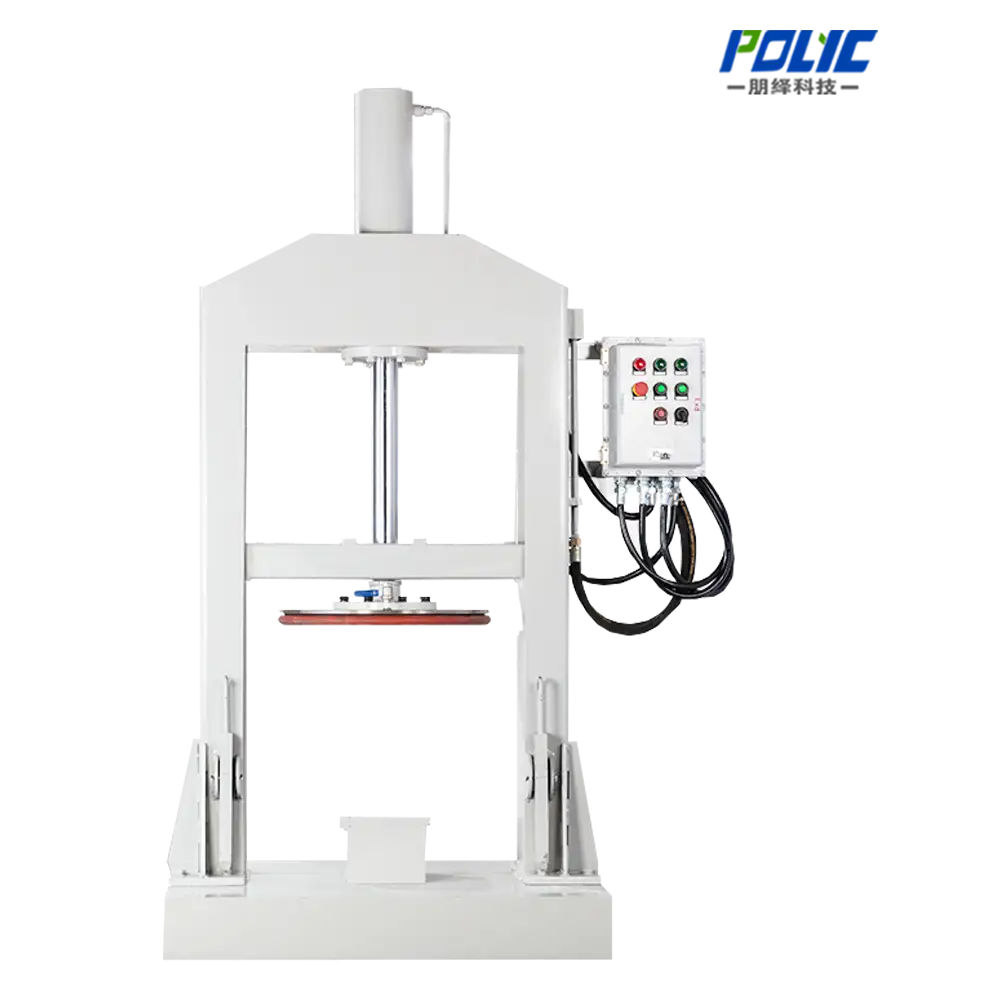


Core Technology & Working Principle
A hydraulic discharge press works by displacement, not by pumping. The ram plate is lowered into the vessel and the hydraulic cylinder forces it down, so the product has nowhere to go but out through the discharge port. Because the driving force is hydraulic pressure rather than a pump impeller, the viscosity ceiling is set by the vessel and the seal, not by the pump curve.
▲ Ram Plate Displacement
The plate matches the vessel bore, so lowering it displaces the whole batch at once. There is no dead volume left clinging to the wall and no cavitation at the inlet, which is what a transfer pump suffers on a paste.
▲ Hydraulic Pressure Control
Pressure spans 0 to 25 MPa, so the same press extrudes a soft sealant at low pressure and a stiff putty at high pressure without changing hardware. The operator sets the pressure to the product, not the other way round.
▲ Seal Matching the Vessel
The seal ring on the plate has to match the mixing vessel bore, because that is what keeps the product moving down instead of squeezing past the edge. Seal grade is selected against your vessel tolerance and product.
Precision Engineered Details
The parts below are what decides whether the press discharges cleanly shift after shift, and what we specify against your vessel rather than from a catalog.
PHD Technical Parameters
The table below covers the four standard PHD frames. Choose by vessel diameter first, because the ram plate has to match the bore, then confirm motor power against your product stiffness.
| Model | Motor Power (kW) | Vessel Diameter (mm) | Ram Plate Diameter (mm) | Max Stroke (mm) |
|---|---|---|---|---|
| PHD900 | 4 | 900 | 900 | 1,150 |
| PDH1000 | 4 | 1,000 | 1,000 | 1,150 |
| PDH1100 | 5.5 | 1,100 | 1,100 | 1,250 |
| PFDH1200 | 11 | 1,200 | 1,100 | 1,250 |
Reference projects in your industry are available on request.
Our Manufacturing Advantages
🏢 Direct Source Factory
Shanghai Polyc Technology Co., Ltd. is not a reseller. Every PHD hydraulic discharge press is machined, assembled and tested at our Wuxi plant, so you buy at the factory price and speak directly to the engineers who built it.
✈️ 30–45 Days Fast Delivery
Standard models ship in 30–45 days from confirmed drawings, thanks to our integrated vertical in-house production lines.
🛡️ Strict Quality Control
Key welds, seals and running accuracy are inspected before assembly, and each machine is run at the factory before packing.
🔧 3-Year Global Warranty
Every unit is covered for three years, with remote video support and spare parts stocked for dispatch worldwide.
Target Application Spectrum
The press is used wherever a mixed batch is too stiff for a transfer pump. These are the four duties it is specified for most often.
Sealants & Adhesives
Silicone, PU and MS polymer batches that will not flow into a filling head under gravity, and that a lobe pump cannot move without cavitating.
Putty & Mastic
Wall putty and car putty at the stiff end of the range, where the press extrudes straight into the filling station on the same line.
Battery Slurry
High-solids cathode and anode pastes discharged from the mixer into coating feed tanks without exposing the batch to air.
Resin & Pigment Paste
Resin solutions and pigment concentrates transferred out of the reaction or mixing vessel at the end of the batch.
Need to Get a High Viscosity Batch Out of the Vessel?
Send us your vessel diameter, batch volume and product viscosity — our engineers will match the ram plate to your bore and confirm the frame and pressure range, then quote directly from the factory.
Technical FAQ
Short answers to the questions plant engineers ask before specifying a hydraulic discharge press.