


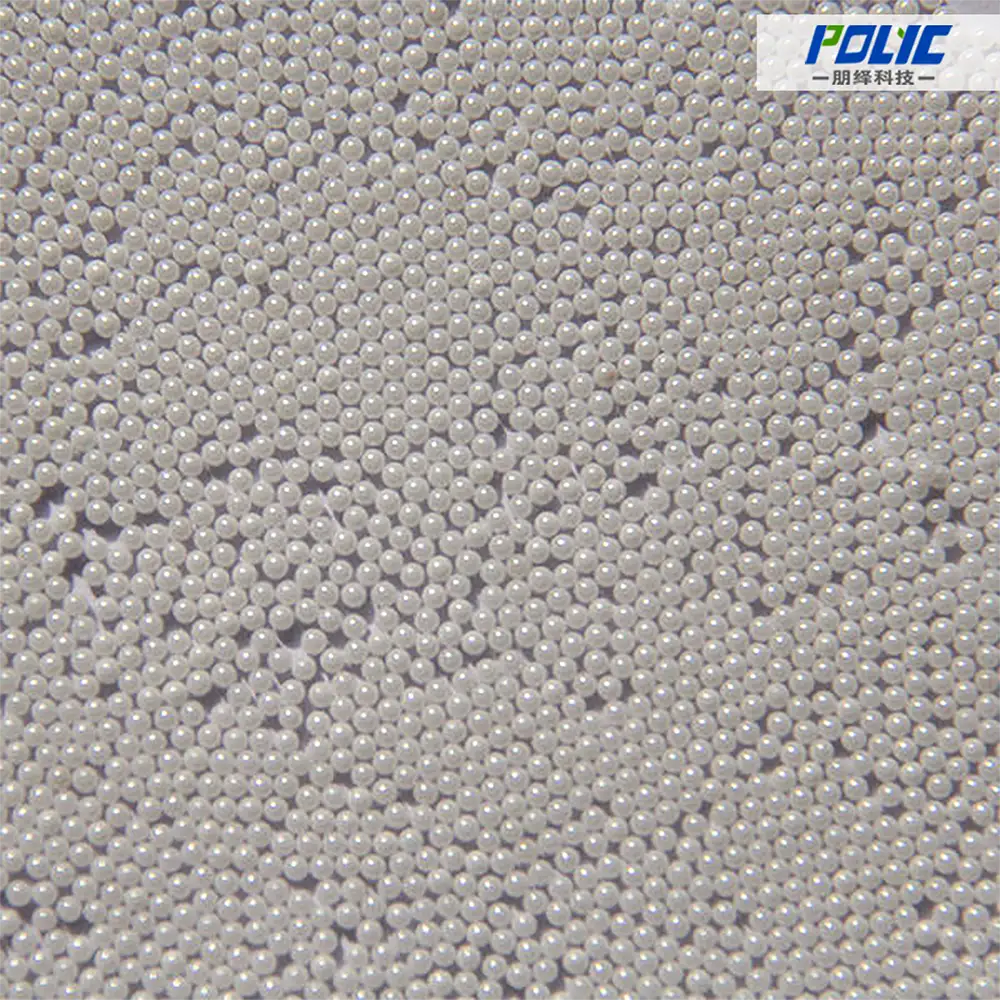

Core Technology & Working Principle
Grinding happens where two beads meet. A mill imparts kinetic energy to the media, and the bead contacts transfer that energy into the agglomerate trapped between them. Dense beads carry more energy per collision, which is why zirconia outgrinds glass at the same shaft speed — and why the same mill reaches a finer result simply by changing media rather than by running harder.
▲ Density Sets Impact Energy
At 6.0 to 6.1 g/cm3, zirconia carries roughly twice the mass of glass bead of equal diameter. The extra mass becomes impact energy at each contact, so a hard or coarse feed breaks down faster at the same tip speed.
▲ Hardness Holds the Size
Above 1250 HV with fracture toughness around 8.0 MPa·m½, the bead resists both abrasion and chipping. A bead that stays round keeps its contact geometry, so the grind curve does not drift as the media ages.
▲ Chemical Inertness
Zirconia does not react with the vehicle, which matters where contamination is not acceptable — cosmetic and electronic materials, and any product where a grey cast from steel media would show.
Precision Engineered Details
The bead is a consumable, and the numbers below are what decide how much of it you buy over a year rather than how it looks on arrival.
Zirconia Bead Specifications
The table below lists the measured physical properties of the 95 percent yttria-stabilized zirconia bead. These are the figures to match against your mill manufacturer chamber and separator rating.
| Property | Specification | What It Decides |
|---|---|---|
| Composition | ZrO₂(HfO₂) 94–96% | Yttria-stabilized tetragonal structure (Y-TZP) |
| Specific density | 6.0–6.1 g/cm³ | Impact energy per collision |
| Bulk density | 3.7 g/cm³ at 1.8–2.0 mm | Chamber charge weight and mill loading |
| Vickers hardness | > 1250 HV (Mohs ≈ 9) | Abrasion resistance and media life |
| Compressive strength | > 2.0 kN at 2 mm bead | Resistance to crushing in the chamber |
| Fracture toughness | 8.0 MPa·m½ | Chipping resistance under impact |
| Self-wear | < 2 ppm | Contamination rate into the product |
| Sphericity | > 96% | Uniform wear and repeatable grind |
| Available sizes | 0.05–50 mm | Fineness target and chamber separator gap |
Reference projects in your industry are available on request.
Our Manufacturing Advantages
🏢 Direct Source Factory
Shanghai Polyc Technology Co., Ltd. is not a reseller. Every Y-TZP zirconia grinding media is machined, assembled and tested at our Wuxi plant, so you buy at the factory price and speak directly to the engineers who built it.
✈️ 30–45 Days Fast Delivery
Standard models ship in 30–45 days from confirmed drawings, thanks to our integrated vertical in-house production lines.
🛡️ Strict Quality Control
Key welds, seals and running accuracy are inspected before assembly, and each machine is run at the factory before packing.
🔧 3-Year Global Warranty
Every unit is covered for three years, with remote video support and spare parts stocked for dispatch worldwide.
Target Application Spectrum
Zirconia media is specified wherever the grind target is fine and the product cannot tolerate contamination. The four duties below account for most of the demand.
Paints & Pigments
Deep-color and high-gloss coatings where a grey cast from steel media would shift the shade, and where a fine grind lifts color strength.
Printing Inks
Inkjet and gravure inks at sub-micron targets, where a narrow particle distribution matters more than raw grinding speed.
Battery Materials
Cathode and anode slurry milling where metal contamination is a functional failure, not just a cosmetic one.
Cosmetics & Fine Chemicals
Products where the media must be chemically inert and the wear rate low enough to keep the batch within specification.
Need Media Matched to Your Mill?
Send us your mill model, chamber volume and target fineness — our engineers will confirm the bead diameter and charge weight, then quote directly from the factory.
Technical FAQ
Short answers to the questions buyers ask before specifying zirconia media.