


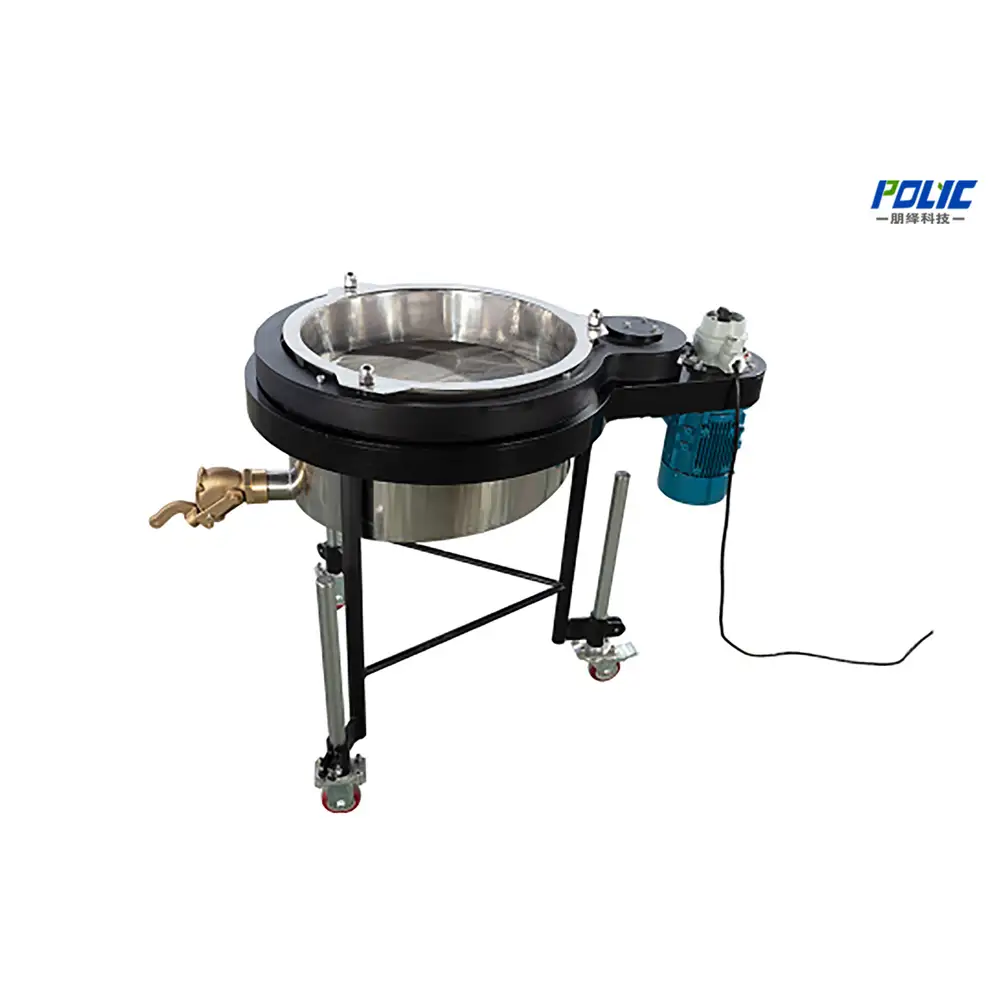


Core Technology & Working Principle
A vibrating sifter does one job in a paint, ink or battery line: it is the last barrier before the product is packed or pumped into a machine that cannot tolerate solids. The PVS achieves that with a three-dimensional multi-plane vibration rather than a simple up-down shake, so material spreads across the screen instead of piling in the center, and liquid drains through the full screen area rather than the ring around the inlet.
▲ Three-Dimensional Screening Motion
The vibration motor drives the screen frame in a compound motion with horizontal, vertical and tilt components. Slurry spreads into a thin, travelling layer across the full screen area, which keeps throughput high and stops wet solids from bridging over the apertures.
▲ Two Positions in One Line
Mounted after a high-speed disperser, the sifter protects downstream horizontal bead mills from oversize grit that would block the separation screen or damage the dynamic seal. Mounted before filling, it works as a terminal safety sieve against skinning flakes and contamination.
▲ Quick-Release Screen Change
The sieve ring clamps over the screen deck, so a mesh change or a wash-down between batches is a matter of releasing the clamp rather than unbolting a fixed ring. That matters on a line running several products per shift.
Precision Engineered Details
These are the components an operator works with every shift, and the ones that decide how quickly the sifter can be cleaned and returned to service.
PVS Series Technical Parameters
Both models run at the same frequency and cover the same mesh range. The choice between them comes down to screen area, motor rating and wetted material.
| Model | Effective Screen Area | Vibration Frequency | Motor Power | Standard Sieve Mesh | Barrel & Wetted Material |
|---|---|---|---|---|---|
| PVS450 | 0.15 m² | 3,000 vpm | 0.55 kW | 60 – 200 mesh | Stainless steel SUS304 / SUS316L |
| PVS500 | 0.20 m² | 3,000 vpm | 0.37 kW | 60 – 200 mesh | Cast aluminum alloy / carbon steel |
Reference projects in your industry are available on request.
Our Manufacturing Advantages
🏢 Direct Source Factory
Shanghai Polyc Technology Co., Ltd. is not a reseller. Every PVS vibrating screen sifter is machined, assembled and tested at our Wuxi plant, so you buy at the factory price and speak directly to the engineers who built it.
✈️ 30–45 Days Fast Delivery
Standard models ship in 30–45 days from confirmed drawings, thanks to our integrated vertical in-house production lines.
🛡️ Strict Quality Control
Key welds, seals and running accuracy are inspected before assembly, and each machine is run at the factory before packing.
🔧 3-Year Global Warranty
Every unit is covered for three years, with remote video support and spare parts stocked for dispatch worldwide.
Target Application Spectrum
The sifter is specified wherever a slurry has to be cleaned of oversize material before it reaches a narrow gap or a customer-facing package. Typical duties:
Coatings & Primers
Safety screening after dispersion and before bead milling, to keep oversize pigment agglomerates out of the mill screen.
Ceramic Inks & Glazes
Removing fired particles and glaze residue that would mark the fired surface or block a print head.
Flexo, Gravure & Inkjet Inks
Terminal filtration ahead of filling, where a single hard particle becomes a rejected print run.
Lithium Battery Slurries
Screening active material paste before coating, so agglomerates do not become electrode defects.
Specify a Vibrating Screen for Your Slurry
Send your material, target mesh rating within the 60 to 200 range, solids loading and required hourly throughput. Our Wuxi engineers confirm the model, wetted material and screen specification, then quote direct from the factory.
Technical FAQ
The questions process engineers ask before adding a vibrating sifter to a paint, ink or battery line.