loading

Professional bead mill, mixers manufacturer and factory - Polyc

Laboratory High Shearing Emulsifier 1
Laboratory High Shearing Emulsifier 2
Laboratory High Shearing Emulsifier 3
Laboratory High Shearing Emulsifier 4
Laboratory High Shearing Emulsifier 5
Laboratory High Shearing Emulsifier 1
Laboratory High Shearing Emulsifier 2
Laboratory High Shearing Emulsifier 3
Laboratory High Shearing Emulsifier 4
Laboratory High Shearing Emulsifier 5

Laboratory High Shearing Emulsifier


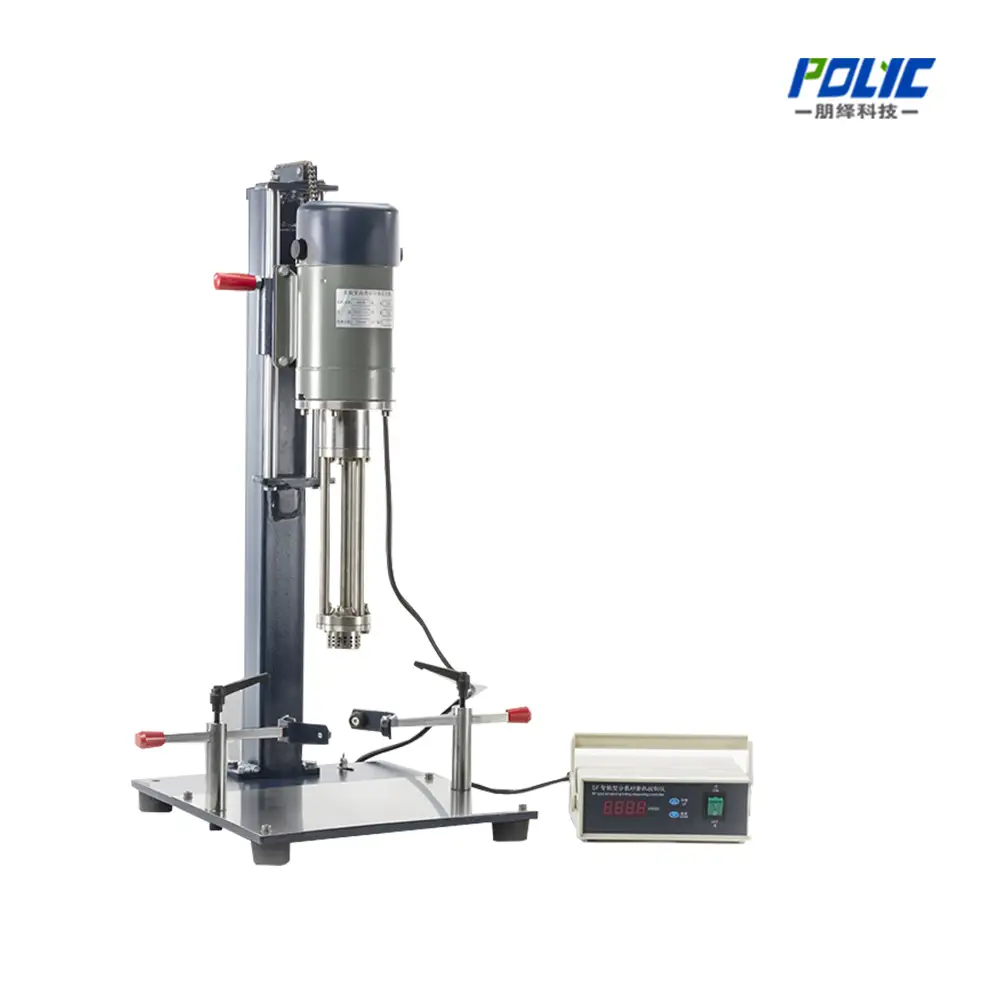
Laboratory High Shearing Emulsifier is the lab type high shearing emulsifier that is widely used in medicine, biological research, cosmetics and lab of colleges. Data gets from experimentation of Laboratory High Shearing Emulsifier also an important reference for your item choice. Enlarge reasonably the lab test data, and it could be your basic parameters of industrial production. By this way, we avoid item choice mistakes and reduce its risk.

5.0
design customization

    oops...!

    no product data.

    Go to homepage

    ✔ Direct Wuxi Factory Pricing ✔ CE Certified & ISO 9001 ✔ 100% Customizable ✔ 3-Year Global Warranty

    PSL / PSF Laboratory High Shear Emulsifier (Rotor-Stator Homogenizer, 10 mL – 10 L)

    The PSL / PSF series is a benchtop rotor-stator homogenizer for laboratories that need to emulsify, wet out or de-agglomerate a sample before committing a formulation to a pilot run. An electronic stepless governor drives a precision stator head, and the digital readout records the exact speed so the same setting can be reproduced on the next batch — or written into the scale-up report.

    Get a Configured Quote Chat on WhatsApp

    Laboratory high shear emulsifier on a stainless stand with digital speed controller and rotor-stator workhead

    10 mL – 10 L

    Working volume range

    200 – 11,000 rpm

    Speed range by model

    Φ10 / Φ18 / Φ70

    Interchangeable stator heads

    SS304 / SS316L

    Wetted contact material

    Core Technology & Working Principle

    A rotor-stator homogenizer works by forcing the product through a fixed screen at high velocity. The rotor turns inside the stator at a small clearance, so liquid is drawn in axially, accelerated at the rotor tips and thrown out through the stator slots. The combination of high shear in the gap and repeated passes through the screen is what breaks droplets and agglomerates, and it is why the same machine cannot be replaced by a simple propeller stirrer of the same power.

    ▲ Shear Happens in the Gap

    Droplet break-up depends on the velocity gradient between rotor and stator, not on the motor rating. A small gap at high tip speed produces the shear; a wide gap at the same power does not.

    ▲ Repeated Passes Through the Screen

    Product recirculates through the stator many times per batch. Each pass adds shear, so total energy input over the batch is what sets the final droplet size rather than a single pass.

    ▲ Stator Geometry Selects the Duty

    Fine mesh favours emulsions, slotted stators favour pigment dispersion, and round-hole heads break coarse agglomerates. The head is a process choice, not an accessory.

    Precision Engineered Details

    The parts below are the ones that decide whether a bench result can be repeated next week, which is the only thing that makes laboratory work worth doing.

    Slotted rotor-stator workhead mounted on a laboratory stand

    Slotted Rotor-Stator Workhead

    The slotted screen generates balanced pumping and shear, which is the general-purpose choice for pigment and polymer dispersion in the 0.3 to 10 L range.

    Rotor-stator head lowered into a clamped beaker on the laboratory stand

    Vessel Clamp and Immersion Depth

    Two quick-action clamps hold the beaker against the rotation torque and let the operator set the immersion depth to the same point on every trial.

    Compact laboratory homogenizer with slim shaft for micro-volume samples

    Micro-Volume Configuration

    A slim 10 to 18 mm head with a lower-power drive covers 10 mL to 1 L, so a few millilitres of formulation can be tested without scaling the batch up to fill a machine.

    Digital speed controller and drive motor of the laboratory emulsifier

    Digital Speed Readout

    The controller shows the actual shaft speed, so a trial is recorded as a number rather than as a dial position, and the same figure can be repeated or handed to production.

    PSL / PSF Technical Parameters

    The three standard models share the same stand, clamps and controller; they differ in drive power, stator size and speed range. Choose by the volume you actually test, then confirm the head diameter against your vessel.

    ModelMotor PowerSpeed RangeWorking VolumeStator HeadNet Weight
    PSL-I0.2 kW200 – 2,200 rpm10 – 1,000 mLΦ10 mm / Φ18 mm11 kg
    PSF-II0.3 kW200 – 11,000 rpm300 – 5,000 mLΦ70 mm (slotted, round-hole, fine mesh)17 kg
    PSF-IV0.4 kW100 – 8,000 rpm300 – 10,000 mLΦ70 mm (slotted, round-hole, fine mesh)25 kg

    Reference projects in your industry are available on request.

    Our Manufacturing Advantages

    POLYC manufacturing plant in Wuxi, certified to CE and ISO 9001

    🏢 Direct Source Factory

    Shanghai Polyc Technology Co., Ltd. is not a reseller. Every PSL / PSF laboratory emulsifier is machined, assembled and tested at our Wuxi plant, so you buy at the factory price and speak directly to the engineers who built it.

    ✈️ 30–45 Days Fast Delivery

    Standard models ship in 30–45 days from confirmed drawings, thanks to our integrated vertical in-house production lines.

    🛡️ Strict Quality Control

    Key welds, seals and running accuracy are inspected before assembly, and each machine is run at the factory before packing.

    🔧 3-Year Global Warranty

    Every unit is covered for three years, with remote video support and spare parts stocked for dispatch worldwide.

    Target Application Spectrum

    The rotor-stator head is specified where the output is a droplet size or a dissolved solid rather than a particle size. The four duties below cover most laboratory demand.

    Creams, Lotions & Gels

    Oil-in-water and water-in-oil emulsions where droplet size sets texture, gloss and shelf stability, tested at 100 mL to 2 L before a pilot run.

    Pigment & Colorant R&D

    Wetting out and de-agglomerating pigment concentrates to compare dispersion quality between two vehicle formulations.

    Polymer & Resin Solutions

    Dissolving granules and powders into solvent or water, where the round-hole head breaks clusters that a stirrer leaves intact.

    Agrochemical Formulations

    Suspension concentrate and emulsion trials that need a repeatable shear history so two candidate formulations can be compared fairly.

    Need a Benchtop Homogenizer Matched to Your Sample?

    Send us the sample volume, the target viscosity and the stator geometry you are considering — our engineers will confirm the model and head, then quote directly from the Wuxi factory.

    Get a Configured Quote Chat on WhatsApp

    Technical FAQ

    Short answers to the questions laboratory managers ask before specifying a rotor-stator homogenizer.

    What is a laboratory high shear emulsifier used for?
    It is a benchtop rotor-stator instrument for reducing droplet and agglomerate size in small batches. Typical duties are emulsifying an oil phase into water, wetting and dissolving powders, and de-agglomerating pigment or polymer solids at sample volumes from 10 mL to 10 L.
    How do the slotted, round-hole and fine mesh stator heads differ?
    The stator is the screen the rotor works against, and the slot geometry sets the shear and the flow. The fine mesh head gives the highest shear for droplet-size emulsions, the slotted head balances pumping with shear for pigment dispersion, and the round-hole head breaks down coarse agglomerates and polymer granules.
    Why does the same machine list different speed ranges for each model?
    Because the stator diameter differs. PSL-I runs a 10 to 18 mm head at up to 2,200 rpm for micro-volumes, PSF-II runs a 70 mm head at up to 11,000 rpm for fine emulsions, and PSF-IV trades speed for torque to drive the 70 mm head through more viscous batches.
    Can the lab emulsifier run on 110 V and 60 Hz?
    Yes. Standard units ship for 220 V 50 Hz single phase, and factory-configured 110 V 60 Hz drive electronics and plugs can be supplied for North American and Latin American laboratory supplies.
    Are SS316L contact parts available?
    Yes. The stator, rotor and immersion shaft can be machined in SS316L with electro-polished or mirror-polished surfaces where the formulation or the cleaning protocol requires a higher alloy than the standard SS304.
    What is covered by the warranty?
    Every unit carries the 3-Year Global Warranty covering the drive motor, the speed controller and the support column hardware, with spare stators, rotors and shafts available from stock.

    Related Resources

    PZM-L Laboratory Basket Mill

    When the bench step is particle-size reduction rather than emulsification.

    View product →

    BPF-H Lab Disperser

    The next volume band up, 5 to 80 L, for pilot batches.

    View product →

    PDM High Speed Disperser

    The production-scale disperser this work scales up to.

    View product →

    Laboratory Dispersion Equipment Selection

    How to choose between a homogenizer, a disperser and a basket mill by sample volume.

    View product →

    Get in touch with us
    Just leave your email or phone number in the contact form so we can send you a free quote for our wide range of designs!
    Related Products
    The company always adheres to the principle of quality first, adhering to the concept of value sharing and service winning, to provide you with more energy saving and more advanced chemical production equipment.
    Contact Us
    Contact person: Peter Yu
    Tel: +86 138 1677 4633
    WhatsApp: +86 138 1677 4633

    Add:
    Shanghai office address: No.712, Block A, Greenland Supreme, 6167-6169, Oriental Meigu Avenue, Fengxian District, Shanghai


    Copyright © 2026 Polyc Machine | Sitemap
    Contact us
    email
    whatsapp
    Contact customer service
    Contact us
    email
    whatsapp
    cancel
    Customer service